 |
Operation Tunnel Exercises in which we explored the depths of Workman Center |
|
The Great Jack WorkmanSometimes the accidents of history produce incredibly fitting tributes. Workman Center on the New Mexico Tech campus was by far the most formidable and complex building on campus (if not the whole state), a fitting tribute to the school's most formidable and complex president. During the Great Depression, the University of New Mexico (UNM) Physics department chair Jack Workman founded a new research division of the Albuquerque school. Even though his group's budget was insignificant—one year, it totaled $300 from the University and a $50 grant from the Virginia Academy of Science—he boldly called it the UNM "Research and Development Division" (R&DD). Workman wanted groundbreaking scientific discoveries but didn't have much funding, so he did a cost-benefit analysis of breakthroughs per dollar in various fields. In those days, folks didn't know much about thunderstorm innards, and Workman realized that New Mexico's thunderstorms are world class. You simply haven't seen a thunderstorm until you've seen a desert thunderstorm. Unlike more humid areas where thunderstorms malinger for hours rumbling and sputtering along, New Mexican thunderstorms pull themselves together in a matter of minutes, spew their fury for a quarter hour, then dissipate, satisfied with a job well done. With help from military contracts, Workman's group was extremely successful. By 1946, Workman's rogue group exceeded 200 people and had so much research grant money coming in that the newly-appointed UNM president wanted a piece of his action. It's called "overhead" now and is the standard accounting scheme schools use to profit from research staff. But Workman refused to give the school any of his grant money when his team did all the research. Workman threatened that if UNM forced him to give up a share of his grants, he'd move the division to the New Mexico School of Mines. Recognizing that the mining trade school had merely 111 students 75 south in the rural desert, UNM called his bluff. But it wasn't a bluff. Soon, Workman and his key people resigned from UNM and were hired by the School of Mines. Tauntingly, they remained in Albuquerque, moving just down the road to a disused girls' school. Not long after, the School of Mines president resigned, and the regents asked their most successful manager on staff—Jack Workman—to be "temporary" president. He held that role for nineteen years, partly because the R&DD's swank girls' school quarters in Albuquerque were seized by the Department of Defense and transformed into Sandia National Labs. Workman and his group decamped to Socorro. During Workman's presidency, the School of Mines' student population rose to 347, the R&DD invented cloud seeding, and the academic program aggressively focused on basic science. (This trend continues to the present day, as even Business majors are required to take 2 semesters each of science-grade Physics, Chemistry, and Calculus to receive their Bachelor of Sciences in Business Administration). In Socorro, Workman's research group was housed in the building that would later bear his name. When he became Institute President, one of the first things he did was scale back the "grossly oversized" Physical Plant, which had grown thick with workers appointed from political patronage. The whole town was up in arms about the out-of-town white physicist who fired home-grown staff. For the next five decades, through confounded architectural hacks, occasional incompetence, and persistent neglect, Physical Plant exacted their revenge on the building named for Jack Workman. Workman CenterBy the time Stealth Force Beta came along in 1990, the New Mexico School of Mines had been renamed "New Mexico Tech" to clarify Workman's heavy pivot toward science, and Workman Center had grown into one of the greatest architectural marvels of the 20th century. It was a behemoth assembled addition-by-addition over the decades that defied description. Its tenants included the Computer Science Department and Computer Center, the Physics Department, the state Bureau of Mine Safety, the Terminal Effects Research Analysis group, a large Paleontology Lab with crates of dinosaur bones, the Bureau of Mines and Mineral Resources, the Machine Shop, and the most complete mineral museum in the Southwest.
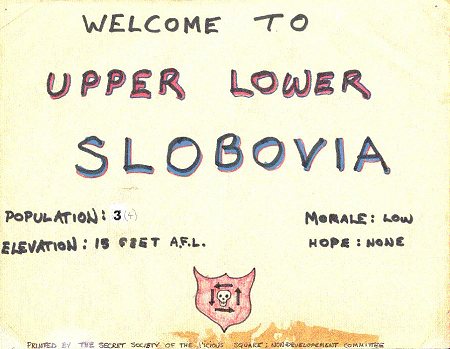
While the overall structure was one single story, atop it were thirteen distinct and very different second floors, none connected to each other except by going back to the first floor. A typical example was a doorway off a side hallway; it led immediately to a long flight of stairs into an area of glass-walled offices the occupants had christened "Upper Lower Slobovia". It was an ADA compliance officer’s nightmare. Another second floor was a slice of the six-story Workman Tower built for atmospheric research, with a rotating cupola on top that looked like an air-traffic control tower, and a secret trap for an elevator (described in Operation High Exploration). There was a coke machine in a major hallway under a looming shower head. In 1991, in one upstairs closet we found the final exams from a 1972 computer class, with a dusty sign telling students about their grades; each exam was a six inch stack of 80-column paper punch cards held together by decaying rubber bands. There was one closet with a colossal fuse panel featuring a 200-amp fuse that had blown years ago, now coated with a half-inch of dust. A large paper drum seismometer operated in the Northwest corner. There was a manhole with an aluminum lid in a hallway. There were mysterious valves on the wall that spewed air and drops of water when opened, mysterious lightswitches that did nothing but activate unseen buzzing mechanisms in the ceiling, and open telephone junction centers in two bathrooms as if one might reconfigure the phone network while using the toilet. The doorway labeled "46" was a locked metal grate about five feet high. A pastime of bored students was to encourage a fellow student (whom we'll call "the victim") to go into the men's room two doors down, stand on the toilet in the lone stall, move aside the ceiling tile, scramble up into and along a large ventilation duct, and then down a small ladder into a tiny enclosed space. This brought the victim to the other side of the locked metal grate. At this point, one of the bored students would flip "on" the lightswitch next to the Machine Shop mailboxes. This switch controlled a gigantic belt-driven contraption that belched out a cacophony of thumps, squeaks, and squeals, taking a good 15 seconds to get up to full speed. The sound was incredible. From the hallway it sounded like the entire industrial revolution was inside bucking for its comeback. To the victim behind the locked grate, it sounded like the world was ending. This was the Workman Center that we all knew and loved. This was the Workman Center that had grown out of the combination of the indomitable spirit of Jack Workman and persistent architectural hooliganism from the Physical Plant. The hidden portions of the building were even more bizarre than the public areas. The crawlspaces above the Computer Center had peculiar hatches in the walls behind which lay objects labeled CLASSIFIED. Attempting to operate the elevator—if you didn't know its secret—would take one to the second floor of the tower, which consisted of a locked grate protecting a few offices, trapping the occupants until someone called the elevator from the ground floor, or the desperate occupants stumbled on its secret. We would learn all about that on Operation High Exploration. All Beta Operatives were insatiably curious about Workman Center. There were hallways that had seemingly been abandoned decades before, and every time we opened a closet, turned a valve, explored a hatch, or flipped a switch, something interesting might happen. With so many interesting things aboveground, we fantasized about what might lurk below. So one night we pushed aside the aluminum manhole cover, and descended.
The TunnelsUnderneath Workman Center was a secret world half as enticing as Narnia. We eventually charted three navigable entrances to the tunnel network:
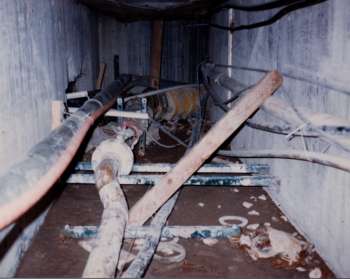
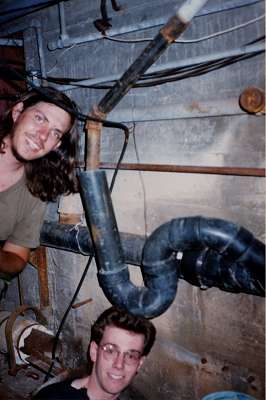
Widespread rumor among the student body alleged anyone caught in the tunnels was expelled. So I asked the Dean of Students—Frank Etscorn, who had survived inventing the Nicotine patch and testing a poorly considered pilot version on himself. He said he didn't remember anybody getting in any special form of trouble after being found in the tunnels. So we explored. Once you got into the tunnel network, you were in a claustrophile's dream come true. None of the tunnels were more than four feet high. In the open tunnels you hunched over dramatically, and in the tunnels with large pipes or miscellaneous debris, you had to shimmy along. Moving about was especially awkward for tall operatives like Operatives Fingers (Jason Coder) and Sasquatch (me)—I'm 6'2". There was one exception, though. Dave Hershberger, despite being 6'1", could somehow scamper up and down the tunnels with phenomenal speed and agility. He so completely outclassed everyone else that we started calling him Operative Rodent. He suspected he'd accidentally developed that fitness as a small child running around his boyhood home with a hunched over impersonation of a Tyrannosaurus Rex.
There were some places where the tunnels were separated from the public areas of the building by a mere metal grate along the baseboard. While it would be a joyous way to enounter a friend, it was practically impossible to recognize passers-by from their shoes, so we thought it best to avoid drawing attention to ourselves.
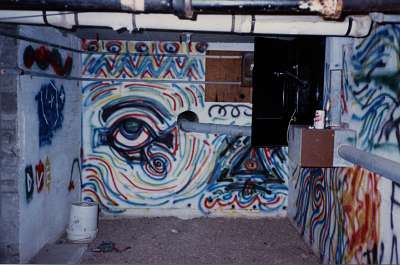
While all the areas had a lot more dust than anything you'd see on the cover of Better Tunnels & Crawlspaces, there were festive areas vibrant with art from a bygone age. There was one room that stood out as a habitable area. It had a ceiling about six feet high, graffiti all over the walls, an inverted 5-gallon bucket to sit on, a shelf with a few empty beer cans, and a feeling of control fostered by a cabinet with fuses 9 inches tall and with a huge lever in the "ON" position. We searched in vain for interesting tunnels under other buildings. Weir Hall had a promising entrance underneath a stairwell, but inside we found only a grungy vermin-infested pit ending after merely ten feet. EpilogueUnfortunately, the finest building on Tech Campus was also the bane of the administration. For years they talked of tearing down the great palace and replacing it with a more "modern" building. They finally got around to it a year after a wave of graduations forced Stealth Force Beta into retirement in 1992. If you go there now, you will find a mockingly bland 3-story "Workman Center" as sterile as any turn-of-the-millennium generic edifice. It has merely one second floor, an elevator without secret codes, and no netherworld of fabulous tunnels. R.I.P. Jack Workman and Old Workman Center. You will both be missed, but never forgotten. | ||||||||||
| E-mail comments to General Sasquatch | Copyright (C) 2003 Tom Jones | Stealth Force Beta Homepage |